
Greetings Warriors!
Have you ever wondered how well you truly know the people around you? I mean really know them. Not the personalities they present in public, the carefully chosen words they speak, or the smiles they offer when everything appears to be going well. I'm talking about the person who exists when nobody is watching, when the expectations of society disappear, and when there is no longer a reason to pretend.
It's an uncomfortable question, isn't it?
We live in a world where appearances have become incredibly important. People spend extraordinary amounts of time cultivating their reputations, projecting confidence, and convincing others that their lives are exactly what they want them to be. We celebrate success while concealing failure, display happiness while suppressing sadness, and sometimes pretend to care about people we secretly dislike.
And perhaps the strangest part of all this is that we have become so accustomed to these performances that we rarely question them.
I recently explored this subject in my article The Art of Pretending: The Masks We Wear and the People We Hide. While researching the relationship between identity and artistic expression, I found myself particularly fascinated by a Belgian painter whose artwork seemed to capture some of humanity's most uncomfortable contradictions.
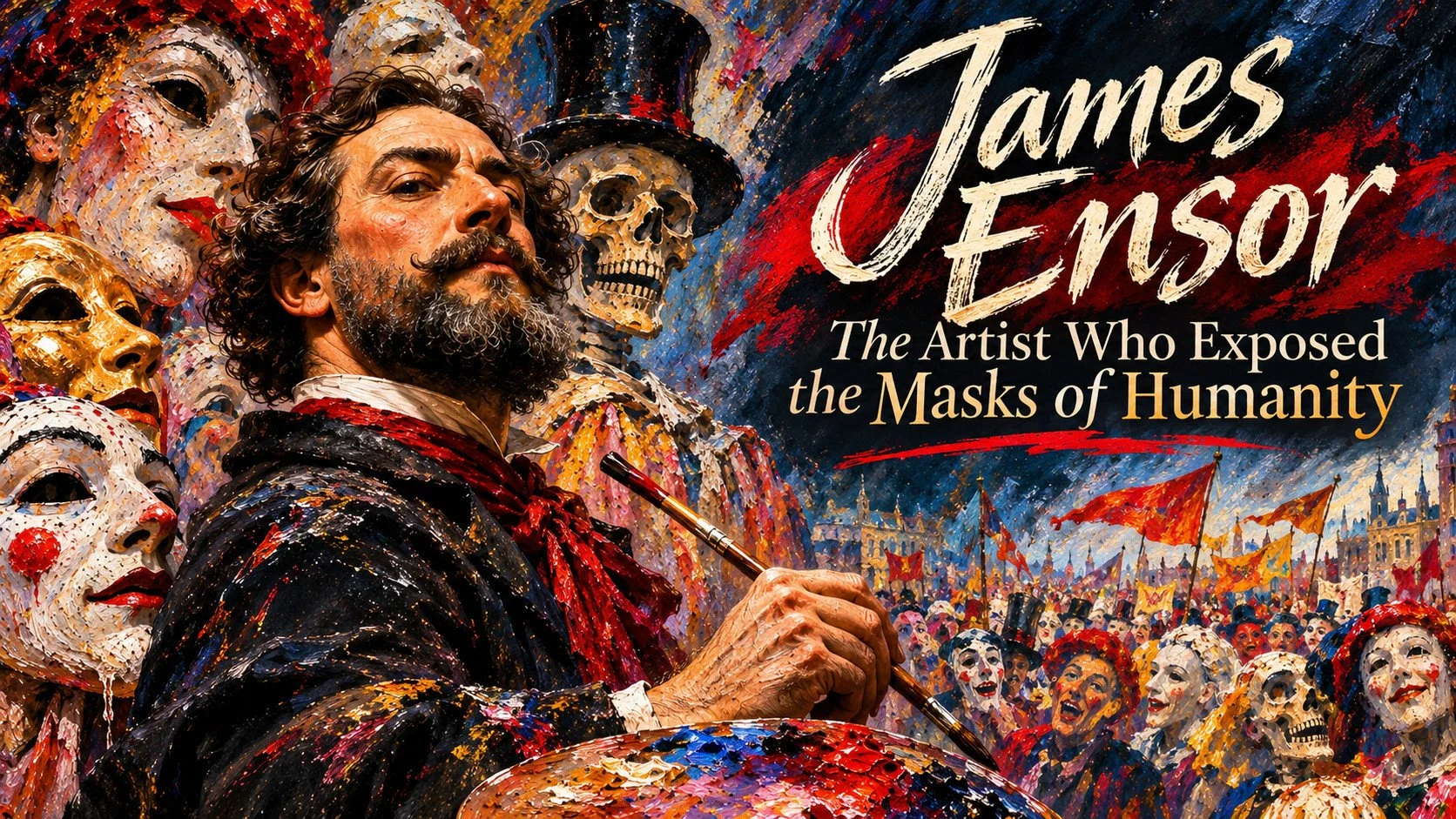
His name was James Ensor.
Born in 1860, Ensor developed an artistic world filled with grotesque faces, theatrical masks, skeletons, strange processions, and unsettling scenes of human behavior. His paintings can appear humorous at first glance, almost like an elaborate carnival where everyone has abandoned the rules of ordinary society.
But spend a little longer examining his work, and the laughter begins to feel uncomfortable. The smiling faces become sinister. The crowds appear threatening. The masks conceal intentions that we cannot fully understand. And somewhere within the chaos, we begin recognizing behaviors that exist in our own world.
What fascinates me most about Ensor is that he wasn't simply interested in creating strange images. His artwork challenged social conventions, mocked hypocrisy, and questioned the institutions and people who claimed to represent respectability. He transformed the familiar carnival mask into something far more psychologically disturbing. And in doing so, he created artwork that continues to feel remarkably relevant more than a century later.
Perhaps the most frightening thing about Ensor's paintings isn't the grotesque faces staring back at us. It's the possibility that we recognize ourselves among them.
Check out my poem book!
Between the wounds of war and the whispers of love lies the battlefield of the heart. These pages bleed passion, ache with loss, and stand defiant in hope. Step inside, where swords clash with sonnets, and discover that even in chaos, love dares to bloom.
James Ensor: The Man Behind the Masks
James Sidney Edouard Ensor was born on April 13, 1860, in Ostend, a coastal city in Belgium. His father, James Frederic Ensor, was English, while his mother, Maria Catherina Haegheman, came from a Belgian family involved in commerce.
His upbringing was unusual, and the environment surrounding him would eventually play an important role in shaping his artistic imagination. His family operated a souvenir and curiosity shop that sold an assortment of objects, including shells, decorative merchandise, exotic curiosities, and carnival masks. Imagine growing up surrounded by strange faces, theatrical disguises, and objects that seemed to belong to entirely different worlds. For a child with a developing imagination, such an environment must have offered endless possibilities. Those masks would eventually become some of the most recognizable elements of Ensor's artistic vocabulary, but their significance would extend far beyond childhood memories.
Ensor demonstrated artistic talent at an early age and eventually studied at the Royal Academy of Fine Arts in Brussels between 1877 and 1880. Like many young artists, he initially worked within relatively conventional artistic traditions, producing portraits, still lifes, and interior scenes. Yet something about the established artistic world failed to satisfy him. Academic painting emphasized particular standards of technique, composition, and acceptable subject matter. Artists were often expected to follow conventions that had been developed and reinforced by influential institutions.
Ensor increasingly moved away from those expectations. He began experimenting with light, color, unusual compositions, and subjects that challenged traditional ideas of beauty. His paintings became more expressive, and his interests shifted toward the absurdities of society, the mysteries of human identity, and the unsettling relationship between life and death.
In 1883, he became a founding member of Les XX, an influential Belgian avant-garde group that sought to create opportunities for experimental artists. One might imagine that an organization dedicated to artistic innovation would naturally embrace Ensor's increasingly unconventional work. Unfortunately, the reality was more complicated. Even among artists who considered themselves progressive, Ensor's imagery could be difficult to accept.
He developed a contentious relationship with critics and members of the artistic establishment, and his sense of alienation became an important part of his artistic identity. What I find interesting about his life is that he did not simply abandon his creative direction when people struggled to understand it. He continued exploring the subjects that fascinated him, even when his work attracted criticism or rejection. And isn't that one of the most difficult challenges any creative person can face? To continue believing in your vision when the people around you insist that you are doing something wrong.
Ensor eventually received significant recognition during his lifetime, including being made a baron by King Albert I of Belgium in 1929. Yet much of his most radical and influential work had been created decades earlier, during periods when recognition was far less certain.
He died in Ostend on November 19, 1949, at the age of 89. By then, his paintings had helped open new possibilities for modern art.
But to understand why his work mattered, we must examine the objects that became central to his artistic universe.
The masks.
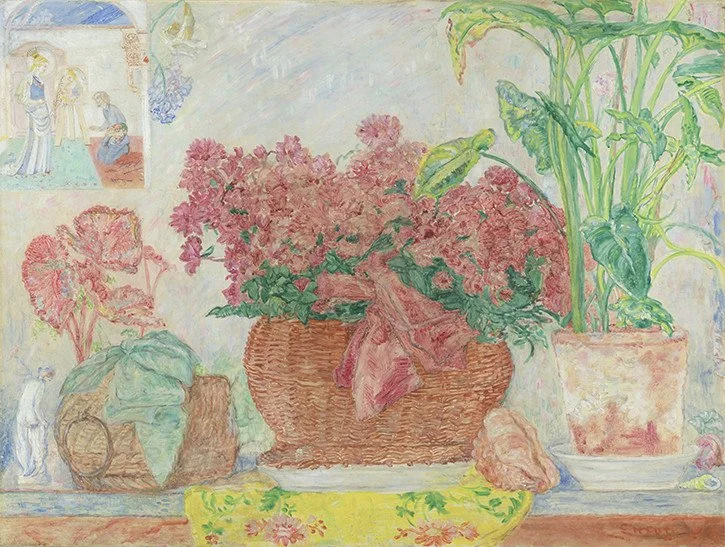
James Ensor - Azaleas (1920-1930)
Why Was James Ensor So Fascinated by Masks?
A mask is a fascinating object because it allows a person to become someone else without physically changing who they are. Put on a smiling mask, and you can appear cheerful while feeling miserable. Wear an intimidating mask, and you can project strength while experiencing fear. Conceal your identity entirely, and you may suddenly feel free to behave in ways you would never consider if everyone knew who you were.
There is something psychologically revealing about that freedom. For Ensor, masks became far more than decorative objects associated with carnival celebrations. They became recurring elements through which he could explore social behavior, hypocrisy, ridicule, and the unsettling contradictions of human nature. His paintings frequently depict exaggerated faces with distorted expressions, enormous noses, artificial smiles, and eyes that seem to stare directly into the viewer. Sometimes the figures appear ridiculous. Other times, they seem almost monstrous. Yet the most interesting aspect of these images is that the masks do not necessarily conceal ugliness. In many cases, they appear to expose it.
Consider how people behave differently depending on their circumstances. Someone might present themselves as kind and compassionate in public while treating others with cruelty in private. Another person may appear supportive of a friend's success while secretly experiencing jealousy or resentment. A person might speak passionately about honesty while carefully concealing their own dishonesty. We encounter these contradictions throughout our lives. And although I don't believe every social performance is malicious, I do believe that human beings are remarkably skilled at creating identities designed to influence how others perceive them.
Ensor's artwork makes these performances visible through exaggeration. Instead of painting respectable individuals with ordinary expressions, he transforms them into grotesque figures whose faces appear to reveal the absurdity of their behavior. It is almost as though he is suggesting that the polished appearances we admire are themselves disguises. But we should be careful not to reduce Ensor's masks to a single interpretation. They also reflected his childhood surroundings, his fascination with carnival traditions, his personal frustrations, and his enjoyment of visual experimentation.
Sometimes they were humorous. Sometimes they were threatening. Sometimes they allowed him to ridicule people or institutions that he believed had treated him unfairly. Their power comes partly from this ambiguity.
A mask can conceal identity, but it can also reveal behavior that someone would otherwise suppress. Think about the way anonymity sometimes changes people's actions. Individuals who would never insult a stranger face-to-face may behave aggressively when they believe their identities are hidden. The mask creates distance between the person and the consequences of their behavior.
And that raises a troubling possibility. Perhaps the mask doesn't always create a false personality. Sometimes it gives an existing personality permission to emerge. I find that thought especially disturbing because it challenges our assumptions about character. We often judge people by how they behave when their reputation is at stake. But perhaps character becomes more visible when there is no audience, no expectation of praise, and no fear of public embarrassment.
Ensor's masks invite us to consider that possibility.
And his most recognizable paintings transform those questions into unforgettable imagery.


The Paintings That Exposed Humanity's Darker Side
To understand James Ensor, we must look beyond his biography and examine the artwork itself.
Three paintings in particular demonstrate how he transformed masks, crowds, and death into powerful visual statements about human behavior.
The Intrigue (1890): The Cruelty Behind the Smile
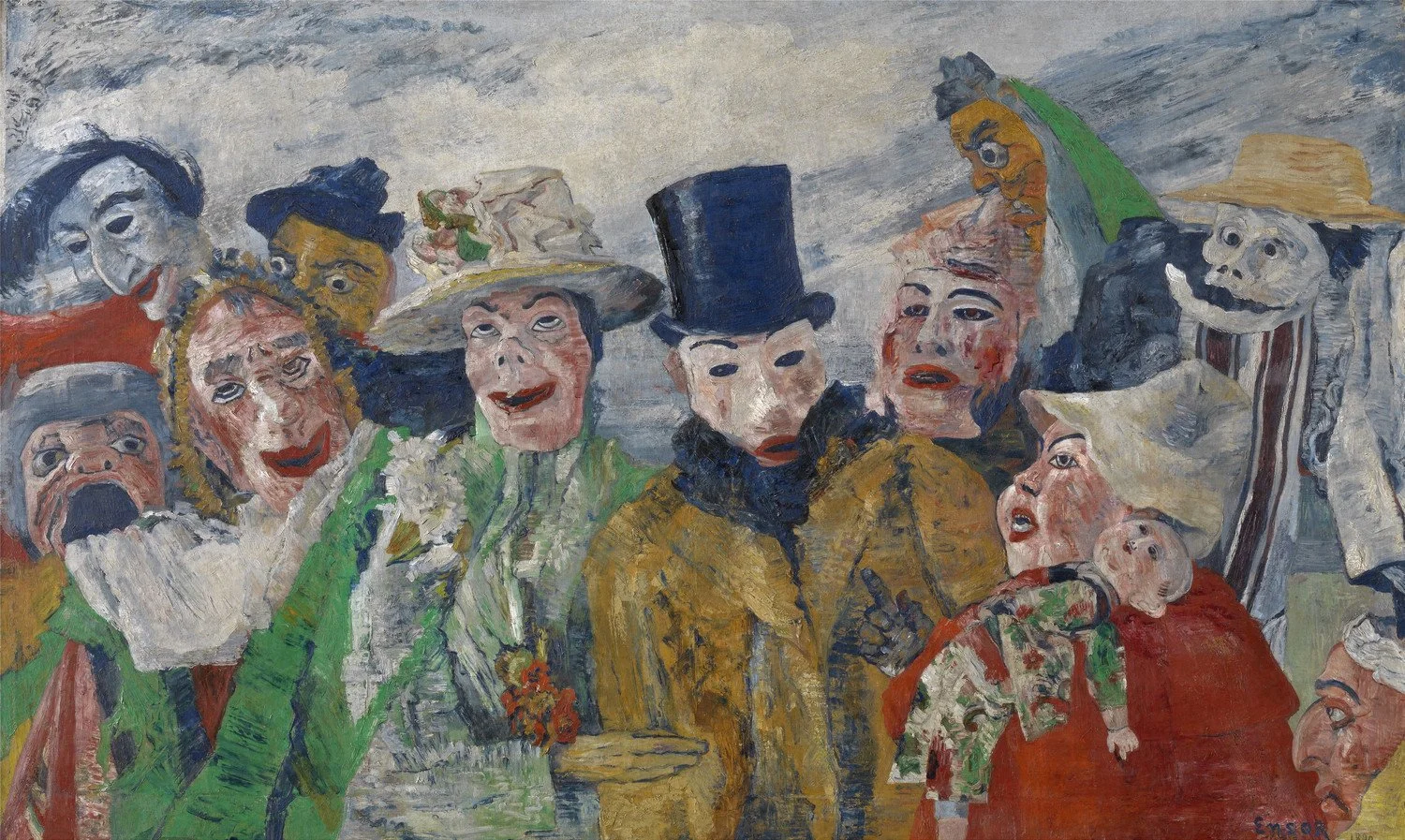
James Ensor - The Intrigue (1890)
In The Intrigue, Ensor presents a gathering of masked figures surrounding a central couple. Their exaggerated expressions create an atmosphere that is simultaneously theatrical, humorous, and deeply unsettling.
Some faces appear amused. Others seem suspicious or hostile. The figures crowd together, creating the uncomfortable impression that the central characters have become the subjects of public scrutiny.
There is something familiar about this scene.
How often have we witnessed people gathering around someone else's personal difficulties, treating private struggles as entertainment?
Gossip can become a form of social currency. People discuss the relationships, failures, and misfortunes of others while convincing themselves that they are merely expressing curiosity.
Sometimes they disguise cruelty as humor. Sometimes they disguise jealousy as concern. And sometimes they participate in the humiliation of another person simply because everyone else is doing it.
The Intrigue can be interpreted through these themes of social hostility and ridicule, although its precise personal references remain open to interpretation. What makes the painting powerful is that we cannot easily determine which figures are sincere and which are performing. The masks deny us that certainty. And perhaps that uncertainty is exactly what makes the scene so uncomfortable.
Christ's Entry into Brussels in 1889 (1888): A Society Consumed by Spectacle
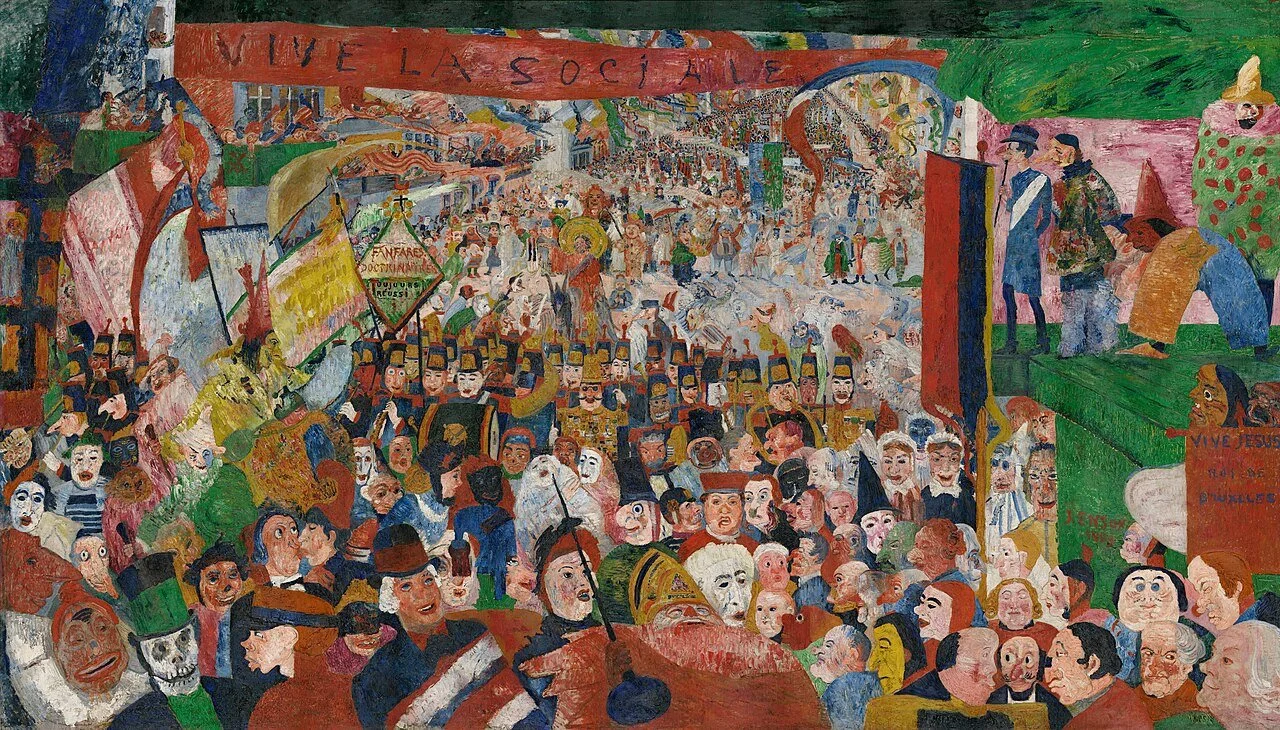
James Ensor - Christ's Entry into Brussels in 1889 (1888)
One of Ensor's most ambitious paintings is Christ's Entry into Brussels in 1889, a monumental canvas measuring approximately 2.5 meters high and 4.3 meters wide.
The painting depicts an enormous procession filled with masked figures, political imagery, banners, musicians, and chaotic crowds.
At the center of this overwhelming spectacle is Jesus Christ, whose presence is surprisingly easy to overlook.
Think about the significance of that composition.
A figure traditionally associated with compassion, sacrifice, and spiritual truth becomes almost invisible amid the noise of public celebration.
The crowd dominates the scene.
The spectacle overwhelms the individual.
And the apparent importance of the occasion becomes secondary to the chaotic behavior of the people participating in it.
The painting has been interpreted as a critique of political, religious, and social hypocrisy, with Christ sometimes understood as a symbolic representation of Ensor himself—an artist who felt misunderstood by the society surrounding him.
I find the imagery particularly relevant to our modern world.
We live in an age where spectacle frequently overwhelms substance.
Important conversations become entertainment. Serious human suffering becomes another topic competing for attention. Public figures perform morality before audiences while the underlying problems remain unresolved.
And sometimes the loudest voices receive the greatest recognition, regardless of whether they have anything meaningful to say.
Ensor created this painting long before television, smartphones, or social media existed.
Yet the overwhelming crowd feels strangely familiar.
It reminds me of the endless noise of modern life, where everyone seems determined to be noticed and genuine meaning can become lost in the performance.
When everyone is fighting to be seen, the things that truly matter can become invisible.
Death and the Masks (1897): The One Truth Nobody Can Escape
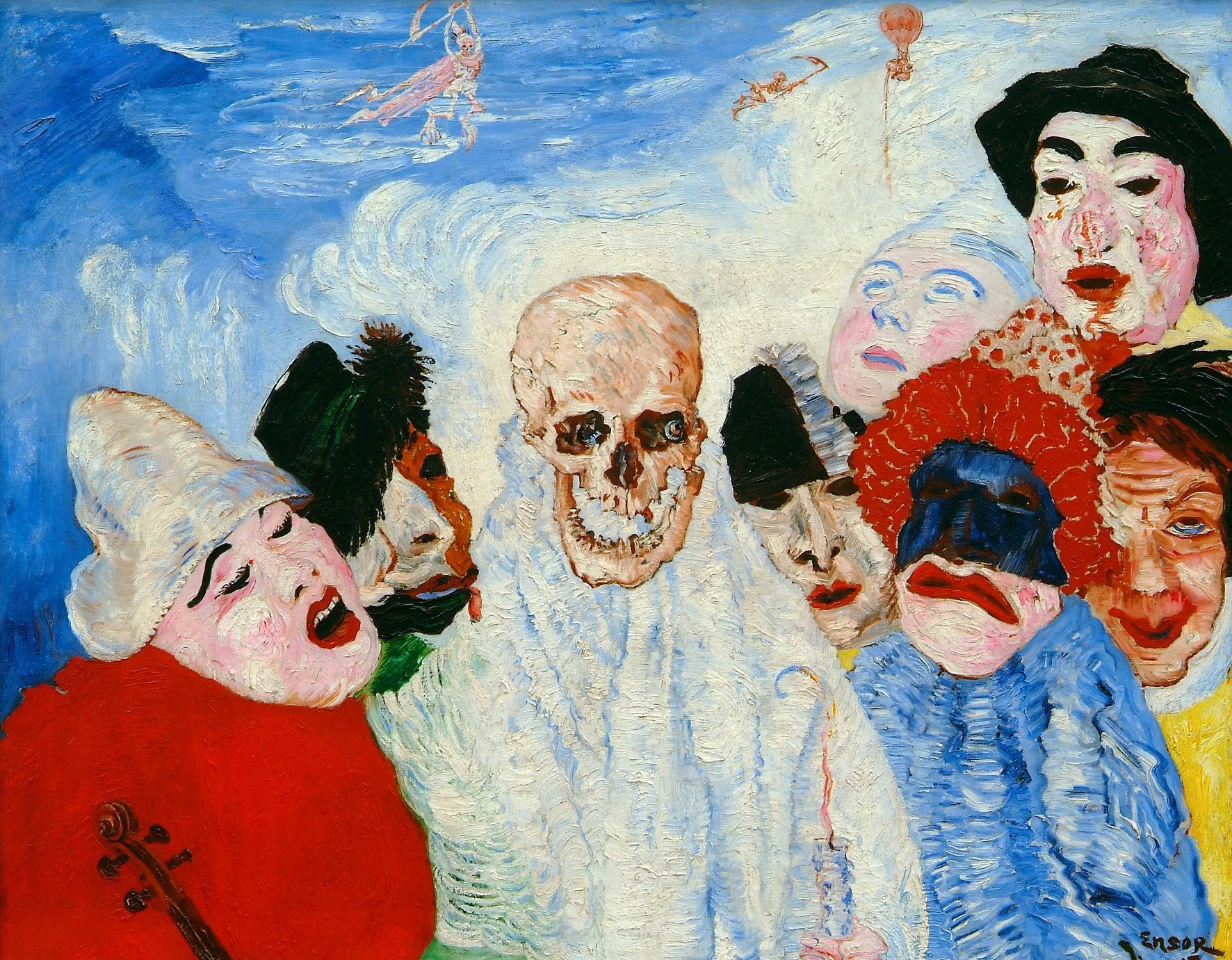
James Ensor - Death and the Masks (1897)
In Death and the Masks, Ensor brings together two of his most recognizable subjects: theatrical disguises and mortality.
A skeletal figure appears among a gathering of masked faces, creating a disturbing contrast between the artificial expressions of the living and the unavoidable reality of death.
What fascinates me about this painting is its ability to strip away the importance we attach to appearances.
We spend so much of our lives concerned with how others perceive us. We pursue status, accumulate possessions, protect our reputations, and sometimes sacrifice our happiness to maintain an image of success.
Yet death remains indifferent to all of it.
It does not care how wealthy we are, how attractive we appear, how many people admire us, or how carefully we have constructed our identities.
Eventually, every performance ends.
That might sound depressing, but I believe there is also something liberating about acknowledging mortality.
If our time is limited, why spend so much of it pretending to be someone we are not?
Why sacrifice meaningful relationships to impress people whose opinions may ultimately have little importance?
Why become so obsessed with appearing successful that we forget to experience the life we are supposedly working so hard to build?
Ensor's skeletons remind us that mortality is the one reality no disguise can permanently conceal.
And perhaps that is why his imagery continues to disturb us.
We can hide our intentions from others, and sometimes even from ourselves. But no mask can protect us from the passage of time.
Rejection, Ridicule, and the Price of Being Different
One of the most fascinating contradictions in art history is how frequently artists who challenge established conventions encounter resistance before eventually receiving recognition. James Ensor experienced this tension throughout important periods of his career.
His unconventional subjects, grotesque imagery, and increasingly experimental compositions did not always fit comfortably within the expectations of contemporary critics and institutions. Even Les XX, the avant-garde group he had helped establish, rejected his monumental Christ's Entry into Brussels in 1889. Imagine the frustration of helping create an organization dedicated to artistic experimentation, only to discover that your own work had become too unconventional for the people who were supposed to embrace innovation.
The painting was not publicly exhibited until 1929, decades after its creation. I find that history revealing because it demonstrates how easily even supposedly progressive communities can establish their own boundaries around acceptable creativity. We often celebrate originality in theory. But when someone produces something genuinely unfamiliar, our initial reaction may be discomfort rather than admiration.
People tend to appreciate innovation once it becomes recognizable, accepted, and validated by influential institutions. Before that happens, originality can look like failure. Of course, rejection alone does not establish artistic greatness. Not every unconventional work is necessarily meaningful or successful. But the history of modern art contains numerous examples of artists whose experiments challenged audiences before influencing later generations.
Ensor was among them. His expressive colors, distorted figures, psychological intensity, and rejection of conventional beauty helped establish him as an important precursor to Expressionism and an influence on later developments in modern art.
What interests me most is not simply that Ensor eventually became famous. It is that he continued developing his artistic vision despite criticism. There is a lesson here that extends beyond painting.
How many people abandon their ambitions because others fail to understand them? How many creative individuals silence their ideas because they fear ridicule? How many people spend their lives pursuing acceptance instead of exploring what genuinely interests them?
We live in a society that frequently encourages individuality while simultaneously punishing people who refuse to conform. We tell others to be themselves, but we often expect them to behave according to our preferences. We praise originality, but sometimes only after someone influential has declared it valuable.
Ensor's career exposes that contradiction. His artwork was not universally celebrated during the period when he was producing some of his most innovative paintings. Recognition developed over time, and his eventual success did not erase the difficulties he encountered earlier.
For artists working today, that history can offer encouragement without creating unrealistic expectations. Not every misunderstood artist will eventually become famous, and artistic success depends on many factors beyond individual determination. But there is still something meaningful about refusing to abandon a creative vision simply because it does not immediately receive approval.
The crowd does not always recognize originality when it first encounters it. Sometimes it takes years for society to understand what an artist was trying to reveal.
BUY MY ART🖤

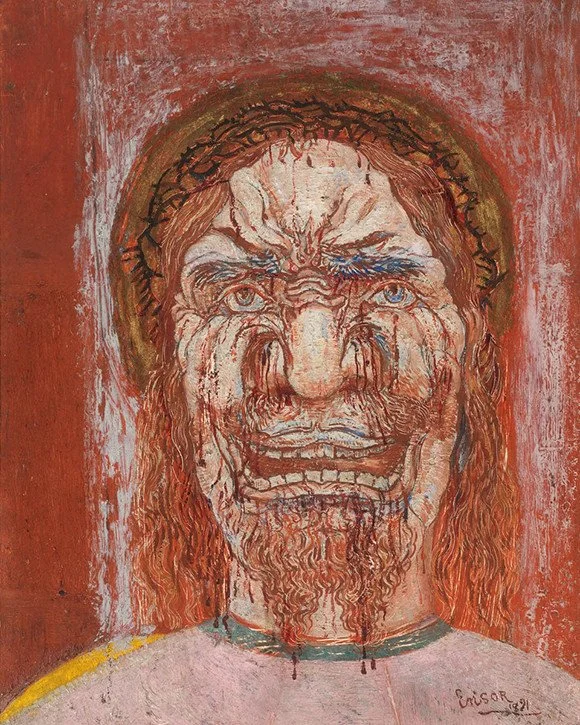
James Ensor - The Man Of Sorrows (1891)
James Ensor and the Strange Performance of Modern Society
What makes James Ensor particularly interesting to me is how relevant his paintings feel in the modern world. More than a century has passed since he created many of his most recognizable works, yet the human behaviors he explored remain remarkably familiar. We still wear masks. Only now, many of those masks are digital.
Social media has created an environment where people can carefully construct identities for public consumption. We select flattering photographs, share our accomplishments, display our happiest experiences, and decide which parts of our lives deserve to remain hidden. We have become curators of our own existence. And in some ways, the endless stream of carefully arranged personalities resembles the chaotic crowds in Ensor's paintings. Everyone appears to be performing. And behind the spectacle, the truth can become increasingly difficult to identify.
Consider how easily public outrage can become entertainment. A person makes a mistake, a crowd gathers online, and thousands of strangers begin offering judgments about someone they may know almost nothing about. Some genuinely want accountability. Others appear more interested in participating in the spectacle. The distinction can become difficult to recognize. Ensor's masked crowds offer a compelling visual metaphor for these situations because individual responsibility can become obscured within collective behavior.
People may say things as part of a crowd that they would hesitate to say alone. They may exaggerate their moral certainty because public approval rewards confidence. And they may become so invested in appearing righteous that they stop questioning whether their own behavior reflects the values they claim to defend. But I also believe we should be careful not to assume that everyone who presents a polished public identity is deliberately dishonest.
Privacy is not deception. A person can share genuine happiness while privately experiencing hardship. Someone can maintain professional composure without concealing a malicious personality. The problem is not that human beings have different sides to their identities. The problem arises when appearances become more important than character.
And this is where Ensor's artwork becomes particularly powerful. His grotesque masks challenge the assumption that respectable appearances necessarily reflect respectable behavior. A beautifully dressed person can behave cruelly. A charming personality can conceal selfish intentions. A person who speaks passionately about compassion can fail to demonstrate it when nobody is watching. Meanwhile, someone who receives little attention or public admiration may quietly possess extraordinary generosity and integrity.
I have always believed that character reveals itself most clearly through actions, particularly when there is nothing to gain. It is easy to appear generous when generosity brings recognition. It is easy to demonstrate kindness when an audience is watching. The greater challenge is maintaining those values when there is no reward, no applause, and no expectation of gratitude.
Perhaps that is one of the most important questions Ensor's paintings encourage us to consider. Are we genuinely becoming better human beings, or are we simply becoming better at convincing others that we are?

Renaissance Man - Inspired by Leonardo Da Vinci
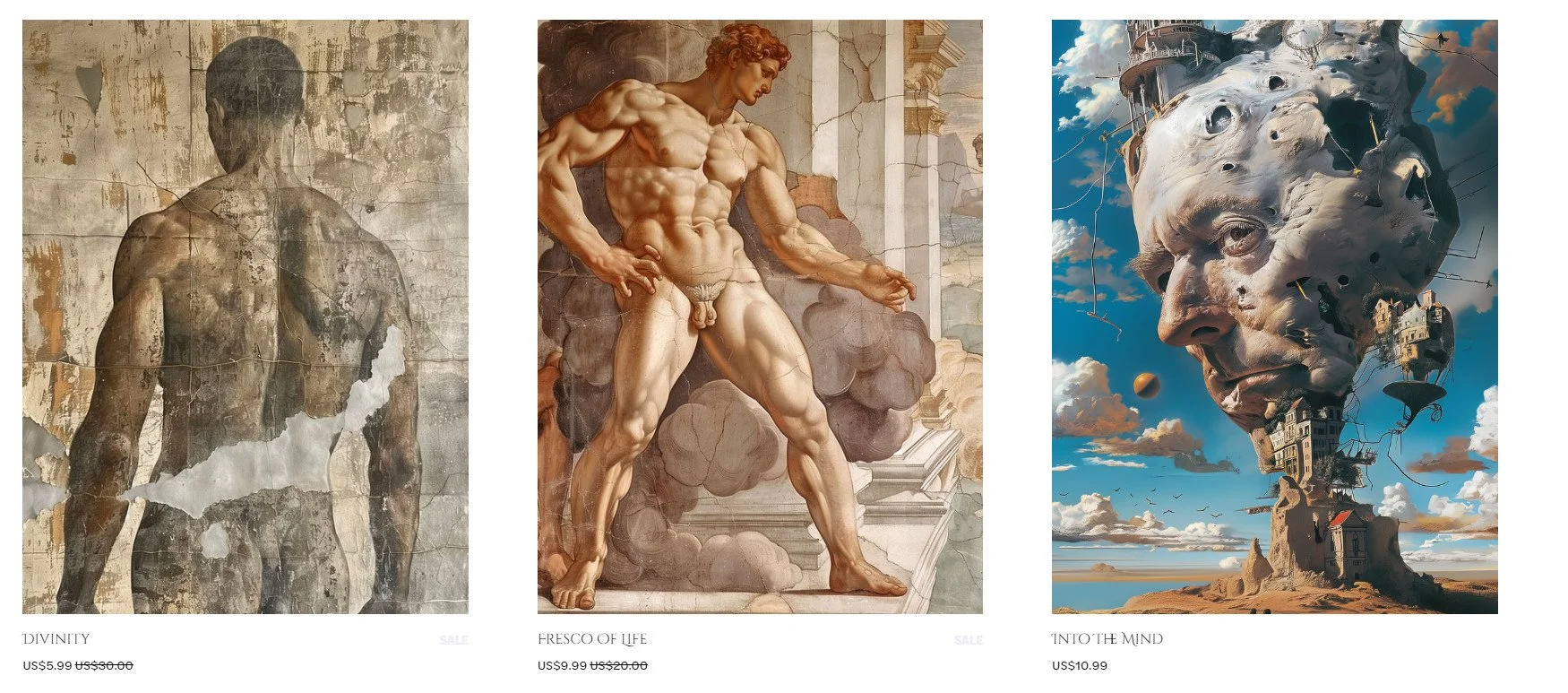
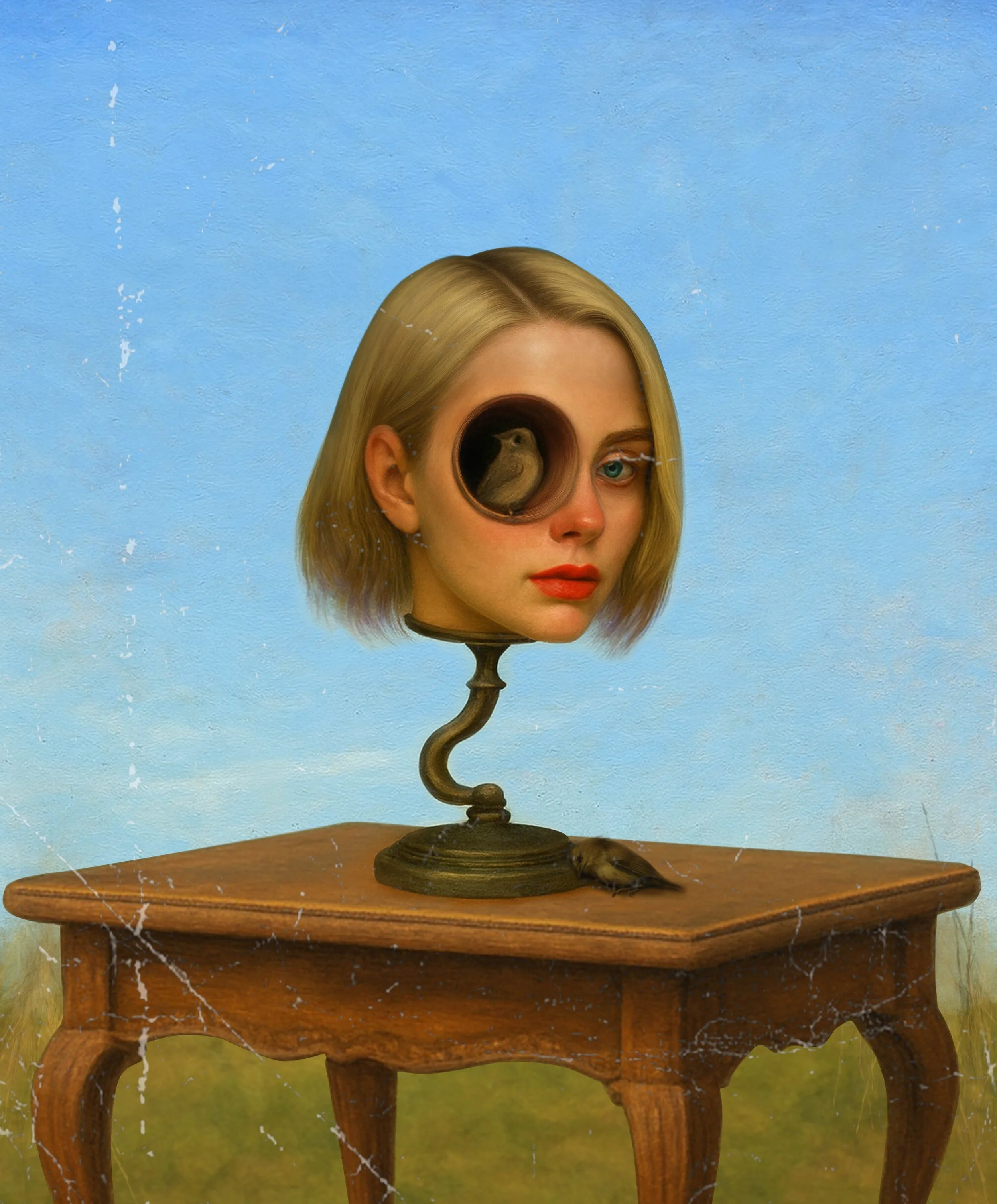
Vosoughi, I Am The Light - 2025
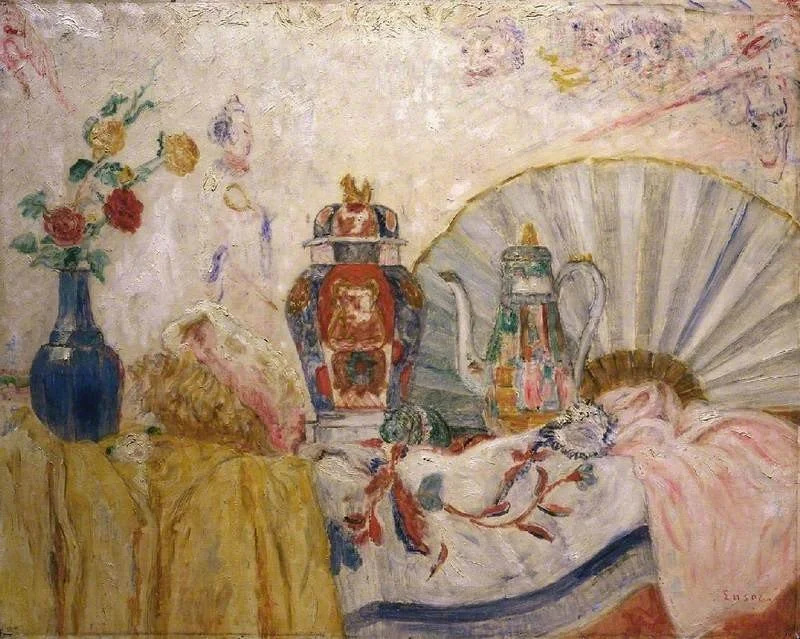
James Ensor - Porcelaines Et Masques (1929)
The Artist Who Found Beauty in Humanity's Ugliness
There is something wonderfully contradictory about Ensor's artistic world. His paintings can be disturbing, grotesque, chaotic, and visually overwhelming. Yet they are also filled with extraordinary creativity. The colors can be vibrant. The compositions are imaginative. The characters possess exaggerated personalities that almost seem to leap from the canvas. Even when he was exploring unpleasant aspects of human behavior, Ensor created works that remain visually fascinating. And that raises an interesting question. Why are we sometimes drawn to art that makes us uncomfortable?
I believe part of the answer lies in art's ability to reveal experiences that ordinary life encourages us to suppress. We don't always want to acknowledge jealousy, resentment, hypocrisy, fear, or mortality. These subjects can make us uncomfortable because they challenge the flattering narratives we construct about ourselves. But art creates a space where those emotions can be examined without requiring us to pretend they do not exist.
Francisco Goya explored the horrors of violence and irrationality. Edvard Munch transformed anxiety and emotional distress into unforgettable imagery. Frida Kahlo used self-portraiture to examine physical and emotional suffering.
Ensor approached humanity through grotesque humor, masks, skeletons, and absurdity. Their artistic languages were different, but their work demonstrates that beauty is not the only reason art matters. Sometimes an artwork becomes important because it reveals something disturbing. As an art enthusiast, I find myself increasingly interested in this relationship between artistic expression and human psychology. I appreciate beautiful paintings, extraordinary craftsmanship, and imaginative compositions. But I also appreciate artwork that challenges my assumptions or forces me to confront uncomfortable questions.
Art does not always need to provide comfort. Sometimes it needs to provoke thought. And Ensor understood the power of provocation. His paintings invite viewers to examine the absurdity of social behavior, the fragility of human identity, and the strange ways people attempt to escape uncomfortable truths. Yet I don't believe his work should be reduced to a simple accusation that humanity is inherently dishonest or cruel.
His artistic world is too complex for that. There is humor alongside hostility, imagination alongside criticism, and playful theatricality alongside disturbing imagery. Perhaps that complexity is precisely what makes his work so compelling. Human beings are not entirely good or entirely evil. We are capable of compassion and selfishness, honesty and deception, courage and cowardice. We can love someone deeply while still disappointing them.
We can believe ourselves to be kind while occasionally behaving cruelly. And we can spend years trying to understand who we are, only to discover that our identities continue changing with experience. Ensor's paintings reflect a world filled with contradictions. And perhaps that is why they feel so human.
Art does not always reveal the world as we wish it existed. Sometimes its greatest achievement is showing us the world we are afraid to acknowledge.
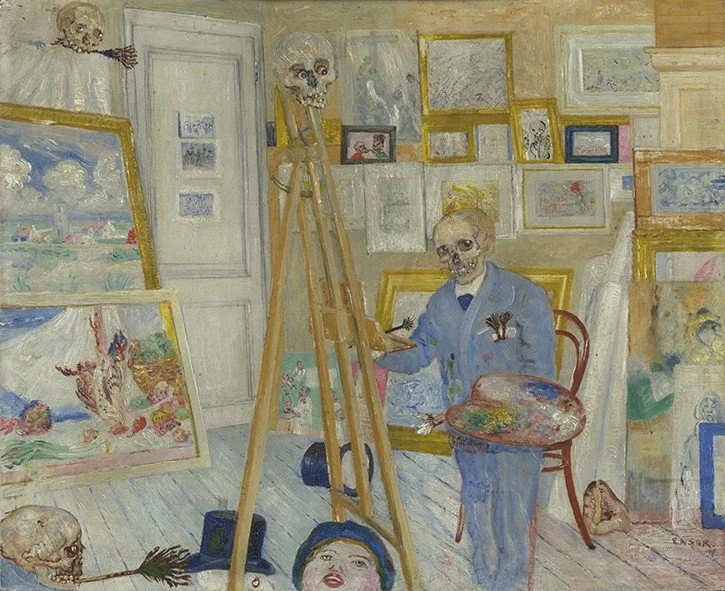
James Ensor - Oil On Panel (1896)
The Greatest Mask Is the One We Wear Before Ourselves
After examining Ensor's life and artwork, I find myself returning to the question that originally drew me toward his paintings.
Who are we beneath the masks?
It is tempting to believe that the answer is simple. Remove the public personality, abandon the carefully constructed reputation, and reveal the authentic individual underneath. But human identity is rarely that straightforward. We are shaped by our experiences, relationships, responsibilities, fears, ambitions, and the expectations of the people around us. Some of the identities we develop are necessary.
A parent may need to demonstrate strength during a difficult family situation. A professional may need to remain composed while managing a crisis. Someone recovering from emotional pain may establish boundaries that prevent further harm. These behaviors are not automatically dishonest. They can be expressions of responsibility, maturity, and self-preservation. But problems arise when we become so attached to our protective identities that we lose the ability to recognize our own needs and emotions.
A person who has spent years presenting themselves as strong may begin believing that vulnerability is unacceptable. Someone admired for generosity may feel unable to say no. A person celebrated for success may become terrified of admitting failure. Eventually, the mask becomes a burden. And perhaps the most dangerous deception is the one we direct toward ourselves.
We convince ourselves that we are happy because admitting otherwise would require difficult changes. We tell ourselves that certain relationships are healthy because acknowledging the truth would be painful. We insist that we are pursuing our dreams when, in reality, we may be chasing expectations established by other people. Sometimes we become so invested in the lives we have constructed that we refuse to question whether those lives still reflect who we want to be.
This is where I believe Ensor's artwork offers its most meaningful lesson. His masks remind us that appearances can conceal uncomfortable realities, but they also encourage us to examine the relationship between identity and truth. We cannot control how everyone perceives us. We cannot force others to understand our intentions. And we cannot prevent people from making assumptions based on the limited parts of ourselves they encounter. But we can attempt to become more honest about our own motivations. We can question whether our actions reflect our values. We can acknowledge our imperfections without allowing them to define our entire existence. And we can learn to distinguish between the boundaries that protect us and the performances that imprison us.
For me, that is where the warrior philosophy becomes particularly relevant. A warrior wears armor because the battlefield is dangerous. The armor protects him from injury, allows him to confront threats, and helps him survive difficult encounters. But imagine a warrior who becomes so accustomed to wearing armor that he refuses to remove it after the battle has ended. He returns home still prepared for conflict. He approaches every conversation as though it were a confrontation. He interprets vulnerability as weakness and kindness as a potential threat. Eventually, the armor that once protected him begins preventing him from experiencing the peace he fought to achieve.
The same can happen with the identities we construct. We become so skilled at protecting ourselves that we forget how to connect with others. We become so concerned with appearing strong that we forget how to acknowledge pain. And we become so committed to maintaining our reputations that we lose sight of the people we genuinely want to become.
A warrior's greatest strength is not his ability to wear armor forever. It is knowing when the battle has ended and having the courage to remove it.
Perhaps the same is true of our masks.
Final Thoughts: When the Mask Comes Off, Who Are We Really?
Warriors, James Ensor was more than an artist who painted grotesque faces and unsettling carnival scenes. He was an observer of humanity's contradictions. Through masks, skeletons, exaggerated expressions, and chaotic crowds, he created an artistic world that challenged social conventions and exposed the absurdities of human behavior.
His paintings remind us that appearances can be misleading, that crowds can conceal cruelty, and that the pursuit of respectability does not always reflect genuine integrity. But I believe his work also offers something more personal. It invites us to question the identities we have created for ourselves. How much of our behavior reflects our genuine values, and how much is influenced by the desire to be accepted?
How often do we conceal our emotions because we fear appearing weak? And how many of us have spent so long pretending to be someone else that we no longer recognize the person beneath the performance? I don't believe we can live without masks entirely. Life requires boundaries, discretion, and the ability to adapt to different circumstances. But there is a difference between protecting our privacy and abandoning our authenticity. There is a difference between demonstrating strength and pretending that we never experience pain. And there is a difference between being respected for our character and being admired for an image we have carefully manufactured.
Perhaps the greatest lesson we can take from Ensor is that we should be less concerned with appearing extraordinary and more concerned with becoming genuinely decent human beings. Because eventually, the crowd disappears. The applause fades. The costumes are removed. And we are left with the person we have become.
When that moment arrives, I hope we can look into the mirror without needing another mask to feel comfortable with what we see.
Until next time, Warriors.
The world may admire the mask you wear, but your true character is revealed by the person you become when nobody is watching.
If you enjoyed this article, you can read more below:
Frida Kahlo Controversy: Why Mexico vs Spain Is Sparking a Cultural Debate