
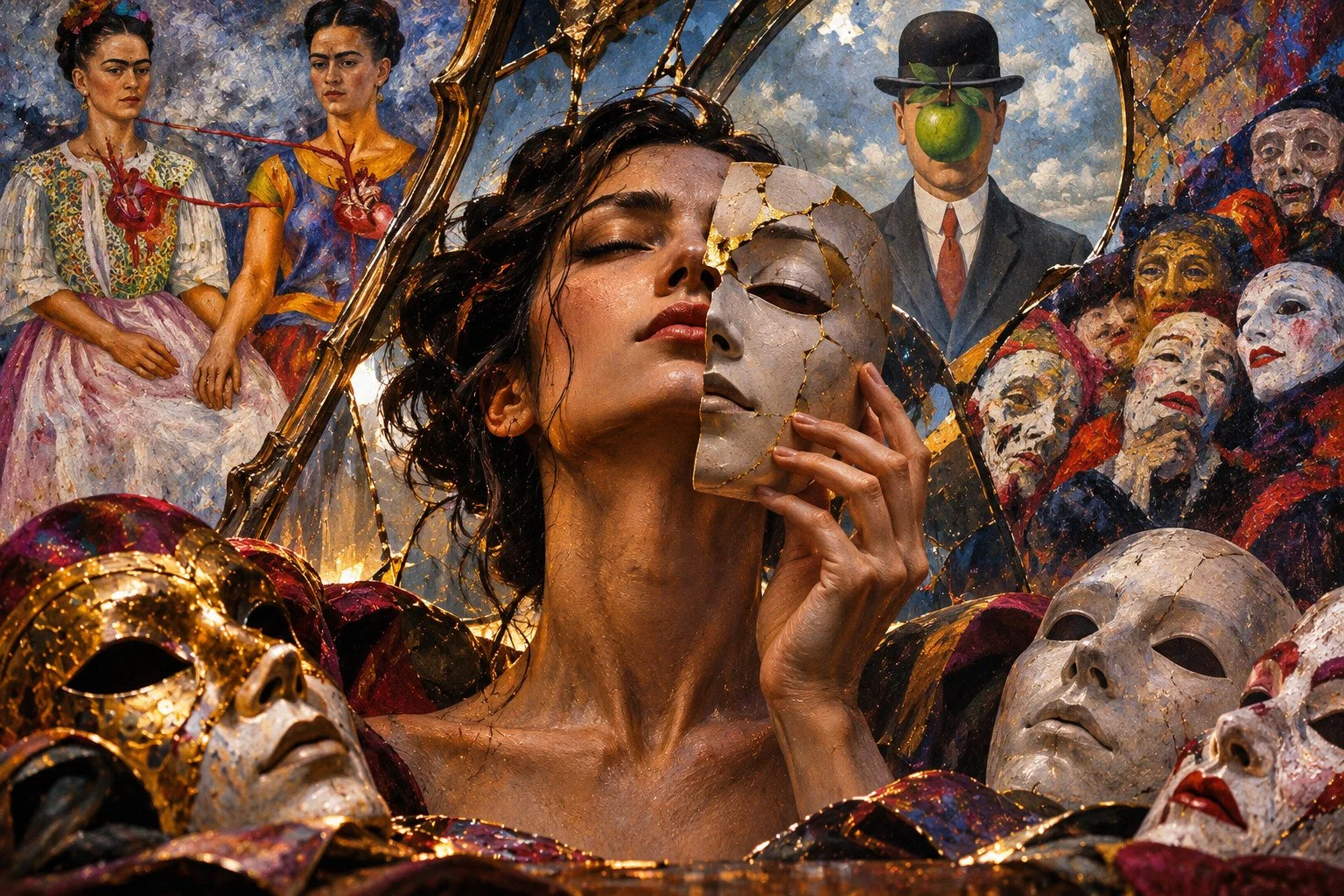
From Frida Kahlo's fractured identity to René Magritte's concealed faces and James Ensor's unsettling masquerades, artists have spent centuries exploring one of humanity's greatest contradictions: our desire to be seen and our fear of being truly known.
Greetings Warriors,
Have you ever looked into a mirror and wondered whether the person staring back at you is truly who you are, or merely someone you have learned to become?
It is a strange question, isn't it? We spend our entire lives developing our identities, building relationships, pursuing careers, and creating impressions of ourselves that we hope others will admire. We learn when to smile, when to remain silent, when to demonstrate strength, and when to conceal our weaknesses. Over time, these behaviors become so natural that we rarely question them. Yet somewhere beneath the confidence, the carefully chosen words, and the personalities we present to the world, there may be another version of ourselves waiting to be acknowledged.
I have always found the human mind fascinating, particularly our ability to conceal what we genuinely feel. A person can be surrounded by friends and still feel terribly alone. Someone who appears confident may secretly struggle with insecurity. A person who constantly makes others laugh might be fighting battles that nobody knows exist. We have become remarkably skilled at presenting ourselves as something other than what we feel inside.
And perhaps the most unsettling part is that we don't always realize we are doing it.
As an art enthusiast, I find myself drawn to works that challenge our understanding of identity and human emotion. Some artists use beauty to communicate their thoughts, while others rely on disturbing imagery, surrealism, symbolism, and psychological tension to expose the contradictions within us. Their paintings can function like mirrors, reflecting aspects of ourselves that we would rather ignore.
Consider the haunting masked figures of James Ensor, the obscured faces of René Magritte, or the emotionally charged self-portraits of Frida Kahlo. Although these artists approached their subjects differently, their works invite us to confront a common question: how much of ourselves do we reveal, and how much do we deliberately conceal?
Perhaps we are all artists in our own peculiar way, painting portraits of ourselves through our actions, relationships, and carefully constructed identities.
But unlike a traditional painting, our greatest masterpiece may also be our greatest deception.
Welcome to the art of pretending.
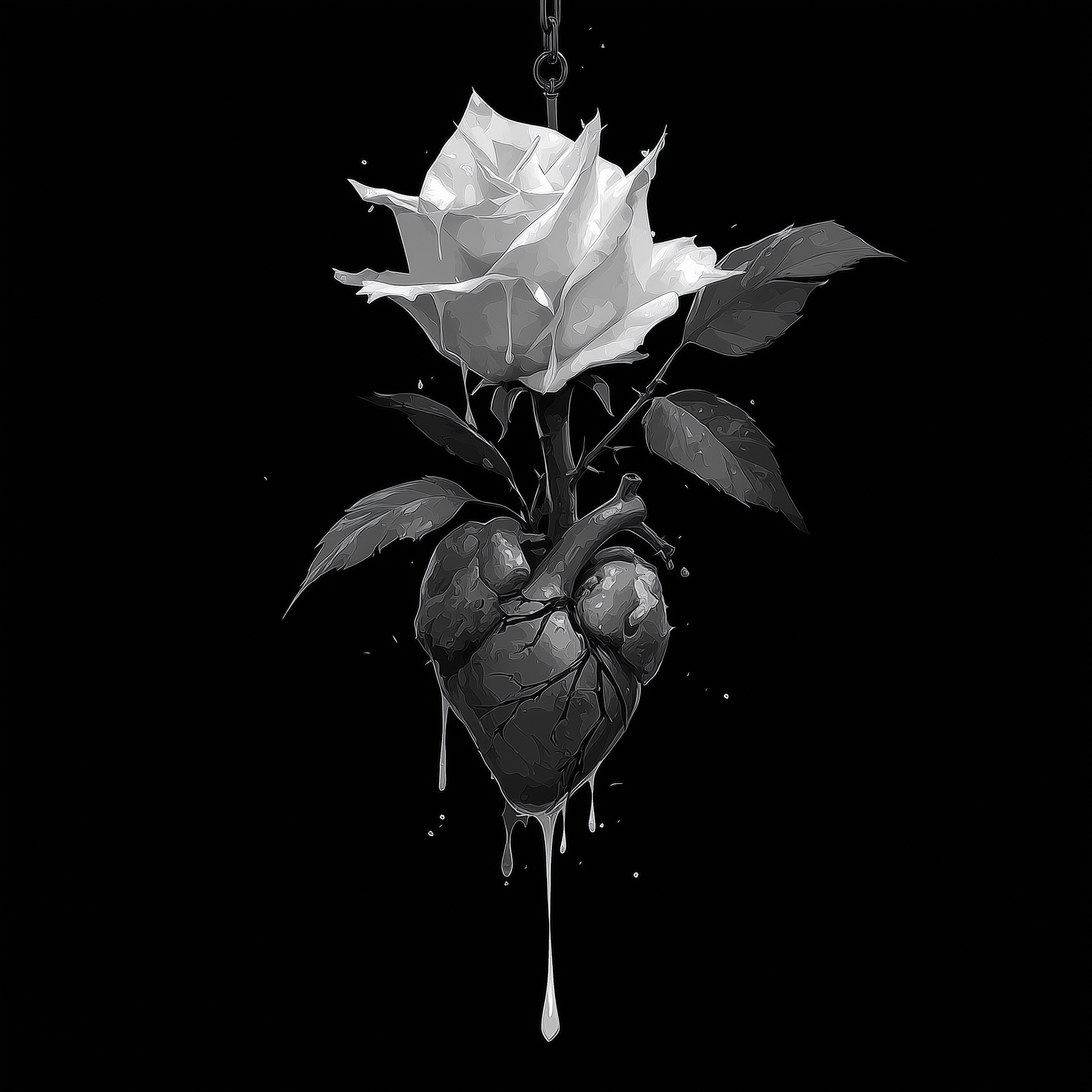
Between the wounds of war and the whispers of love lies the battlefield of the heart. These pages bleed passion, ache with loss, and stand defiant in hope. Step inside, where swords clash with sonnets, and discover that even in chaos, love dares to bloom.
Where love, loss, fear, hope, and memory quietly coexist. Love is not always loud or perfect; sometimes it is heavy, tender, and aching, shaped by time and experience. These words were born from moments of connection and moments of absence, from caring deeply and learning how to let go. Within these pages is an attempt to honor love in all its forms—the kind that holds us together, the kind that breaks us open, and the kind that teaches us how to keep going.
The Face We Show the World Is Rarely the Face We See in the Mirror
Every morning, millions of people begin a performance without ever stepping onto a stage. We prepare ourselves for the day, choose what to wear, organize our thoughts, and mentally rehearse the responsibilities waiting for us. Before we even leave our homes, we may have already decided which version of ourselves the world will encounter.
At work, we become professionals who are expected to remain composed under pressure. Around friends, we might become entertaining personalities who make everyone laugh. With family, we assume roles shaped by years of expectations and responsibilities. In romantic relationships, we sometimes emphasize our most desirable qualities while carefully concealing the insecurities we fear might make us less lovable.
None of this necessarily means we are being dishonest. Human identity is complex, and adapting our behavior to different environments is a normal part of social life. The problem arises when we begin confusing the roles we perform with the entirety of who we are.
Few artists explored the complexity of identity as powerfully as Mexican painter Frida Kahlo. In her extraordinary 1939 painting The Two Fridas, Kahlo presents two versions of herself sitting side by side, their exposed hearts connected by a blood vessel. One wears a European-style white dress, while the other wears traditional Tehuana clothing. The painting emerged during a period of profound emotional turmoil surrounding her separation from Diego Rivera, and it has frequently been interpreted through themes of heartbreak, cultural identity, vulnerability, and divided selfhood.
What makes this painting so compelling is that neither figure needs to be understood as an imitation. Both represent dimensions of the same woman, suggesting that identity is not always a singular, easily defined condition.
We are capable of being strong and vulnerable, loving and resentful, confident and uncertain. These contradictions do not automatically make us hypocrites; they make us human.
Yet society often pressures us to present a consistent identity. Once people become accustomed to seeing us as strong, they may struggle to understand our moments of weakness. Once we establish ourselves as successful, admitting failure can feel humiliating. Once we become known as the person who always helps others, asking for assistance may feel almost impossible.
Eventually, we begin protecting the image that others have created of us, even when maintaining that image comes at a tremendous emotional cost.
I often wonder how many people are exhausted not because of the responsibilities they carry, but because of the identities they feel obligated to maintain. Perhaps the greatest deception is not the face we present to others, but the belief that we must remain that person at all times. We are not always pretending because we want to fool the world. Sometimes we are pretending because we are afraid the world will reject the person beneath the performance.

"Potion Number 9" is an enthralling piece of abstract art that captures the essence of mystery and transformation. The artwork serves as a visual representation of alchemy, blending ethereal forms and vibrant colors to create a potion of visual enchantment.
James Ensor and the Masks That Conceal Our Humanity
If Frida Kahlo explored the different identities existing within a single person, Belgian artist James Ensor (1860–1949) approached the subject through something far more unsettling: masks.
Ensor's paintings frequently feature grotesque faces, distorted expressions, theatrical disguises, and crowds of strange figures whose appearances seem to blur the boundary between humanity and caricature. His compositions can feel chaotic, humorous, disturbing, and deeply critical of social behavior.
In The Intrigue (1890), a gathering of masked figures surrounds a central couple, creating an atmosphere of suspicion and psychological discomfort. Their exaggerated faces and theatrical appearances transform an ordinary social encounter into something sinister.
The masks invite us to consider the difference between outward appearance and hidden intention. What makes Ensor's imagery so fascinating is that masks can serve several purposes simultaneously. They conceal identity, create alternative personalities, and allow people to behave in ways they might otherwise avoid. A mask can provide freedom, but it can also become a convenient hiding place.
Think about how often we encounter similar behavior in everyday life. People smile at individuals they secretly dislike. They offer compliments they do not genuinely mean. They express sympathy while privately celebrating another person's misfortune. Some carefully construct reputations for kindness, generosity, or moral superiority while behaving quite differently when nobody is watching.
Of course, social politeness should not automatically be mistaken for deception. There are perfectly reasonable occasions when we conceal irritation, disappointment, or private thoughts out of respect for others. But there is a meaningful difference between exercising discretion and deliberately manufacturing a false identity. The danger begins when pretending becomes a way of life. Someone who repeatedly presents themselves as generous may eventually become more concerned with appearing charitable than actually helping people. A person obsessed with being admired for honesty may selectively reveal truths that strengthen their reputation while concealing those that threaten it.
In these situations, the mask becomes more important than the person wearing it. I find this particularly relevant to the way we judge character. We often believe we understand people because we have witnessed their public behavior, yet public behavior reveals only part of the story. The individual who speaks eloquently about compassion may lack empathy in private, while the quiet person who rarely receives recognition may demonstrate extraordinary kindness when nobody is paying attention.
Ensor's paintings remind us that appearances can be profoundly misleading. And perhaps the most dangerous masks are not the ones designed to deceive strangers, but the ones we become so comfortable wearing that we begin deceiving ourselves. A mask is useful when it protects us from danger. It becomes a prison when we forget how to remove it.
René Magritte: The Mystery of the Face We Cannot See
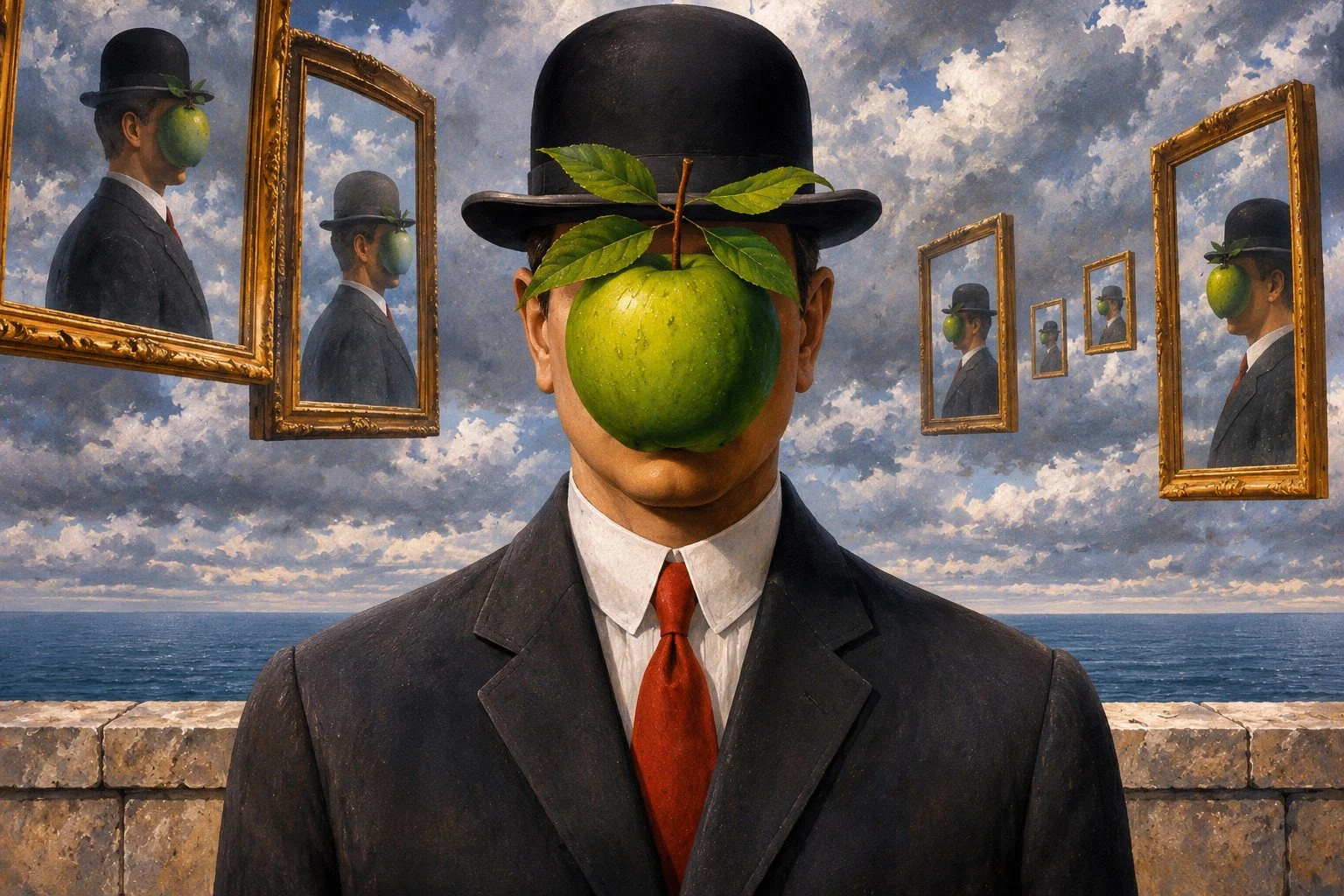
Few paintings capture the strange relationship between visibility and concealment as effectively as René Magritte's The Son of Man.
The Belgian Surrealist depicts a man wearing a dark suit, red tie, and bowler hat, standing before a low wall with the sea and cloudy sky behind him. Everything about the figure appears relatively ordinary, except for one remarkable detail: a green apple floats directly in front of his face, concealing much of his identity. The composition is simple, yet its psychological implications are extraordinary. We can see the man's clothing, posture, and surroundings. We have enough information to construct assumptions about his personality, social position, and perhaps even his character. Yet the feature we instinctively seek when attempting to recognize another human being remains hidden.
Our curiosity immediately turns toward what we cannot see. Magritte explored the tension between visible appearances and concealed realities throughout his career, and The Son of Man has become one of the most recognizable examples of that fascination. But I believe this painting offers an equally powerful metaphor for modern relationships. How often do we believe we know someone simply because we understand their habits, interests, profession, or public personality? We may spend years around a person without fully understanding their fears, disappointments, regrets, or unspoken desires.
Sometimes the mystery exists because they deliberately conceal those feelings. Other times, it exists because we never think to ask. And occasionally, we become so attached to our assumptions about someone that we stop seeing who they actually are. This becomes particularly complicated in romantic relationships. People sometimes fall in love with the possibility of who another person might become rather than accepting who that person is today. They imagine a future in which undesirable behaviors disappear, emotional distance is overcome, or fundamental incompatibilities somehow resolve themselves. At the same time, the desire to be loved can encourage us to present carefully selected versions of ourselves.
We might conceal our vulnerabilities because we fear appearing weak. We might exaggerate our accomplishments because we want to seem impressive. We might pretend to enjoy things we dislike because we believe shared interests will strengthen the relationship. Over time, these small performances can create an uncomfortable question. If someone falls in love with the person we have been pretending to be, do they truly love us? And if we finally reveal our authentic selves, will that love survive?
The tragedy is that pretending can sometimes succeed in attracting the very affection we desire while simultaneously preventing us from feeling genuinely understood.
Magritte's concealed face becomes a symbol of this contradiction. We can stand directly in front of someone, allow them to examine nearly every visible detail of our lives, and still remain emotionally hidden. Being seen is not the same thing as being known.

Social Media: Humanity's Greatest Exhibition of Carefully Constructed Identities
If artists like Kahlo, Ensor, and Magritte were exploring the complexity of identity decades ago, I can only imagine what they might think of the world we inhabit today. Social media has transformed ordinary human existence into a continuous exhibition of carefully selected moments.
We photograph our happiest experiences, share our accomplishments, document our relationships, and present carefully arranged fragments of our daily lives to audiences that may include friends, family, acquaintances, and complete strangers. In many ways, we have all become curators of our own personal galleries. And like museum curators, we decide what deserves to be displayed. We select flattering photographs while deleting the ones we dislike. We celebrate victories while remaining silent about defeats. We share beautiful moments from relationships without necessarily revealing the conflicts that occur behind closed doors.
A person might post photographs from an expensive vacation while privately worrying about unpaid bills. Someone might share motivational messages every morning while struggling to find happiness in their own life. Another individual might present a seemingly perfect relationship while experiencing emotional loneliness that nobody outside the home understands.
This doesn't mean every social media post is dishonest. Happiness can be genuine even when life is difficult, and people have every right to protect their privacy. The problem begins when we mistake carefully selected moments for complete representations of reality. We compare our ordinary lives, filled with uncertainty and imperfection, against the polished highlights of other people's experiences. We see their celebrations but not their disappointments, their achievements but not their failures, and their smiles but not the moments when those smiles disappear.
Eventually, we may begin believing that everyone else has somehow mastered the art of living while we alone are struggling.
I find this particularly interesting because I spend considerable time engaging with artists and collectors on social media. Through platforms like X, I have discovered extraordinary artwork, developed relationships with creative individuals, and witnessed the generosity and passion that exist within artistic communities.
But I also recognize that what we share online represents only part of who we are. An artist may post a breathtaking painting without revealing the months of uncertainty, frustration, and financial difficulty that accompanied its creation. A collector may proudly display an impressive collection while privately questioning the decisions that led to certain purchases. The public sees the finished presentation, not necessarily the emotional journey behind it. And increasingly, social media rewards the presentation itself.
Attention becomes a form of currency. Approval is measured through likes, shares, and comments. Personal experiences are sometimes evaluated according to how well they might perform before an audience. This creates an uncomfortable possibility: instead of simply living our lives, we may begin arranging them for public consumption.
We become performers, audiences, and critics simultaneously. Perhaps the most troubling consequence is that we can become so preoccupied with documenting happiness that we forget to experience it. We have created a world where millions of people are constantly showing themselves, yet countless individuals still feel invisible.

The Emotional Price of Being Loved for Someone You Aren't
There is a particular kind of loneliness that comes from being surrounded by people who admire a version of you that you no longer recognize. Imagine spending years becoming exactly what everyone expects you to be. You become the dependable friend who always offers advice, the strong parent who never appears overwhelmed, the successful professional who always has an answer, or the romantic partner who continually sacrifices personal needs to preserve harmony.
People admire you. They depend on you. They tell you how much they appreciate your strength, generosity, confidence, or patience. But privately, you begin wondering whether their admiration would survive if you stopped performing. Would they still respect you if you admitted you were struggling? Would they remain close if you could no longer provide the support they had grown accustomed to receiving? Would they love you if you stopped agreeing with their expectations and began expressing what you genuinely wanted?
These questions reveal one of the most painful consequences of maintaining a false identity. You may receive enormous amounts of attention and affection while feeling that nobody truly knows you. I believe this experience can be especially difficult for people who have spent much of their lives being strong for others.
Society often celebrates resilience, and for good reason. The ability to endure hardship, overcome adversity, and continue moving forward is admirable. But resilience can become a burden when people begin expecting strength without interruption. A person who has survived extraordinary hardship may feel ashamed to admit that they are exhausted. Someone who has spent years protecting others may struggle to acknowledge that they also need protection. And the longer this performance continues, the more difficult it becomes to abandon.
This is where my warrior philosophy takes on a different meaning. We often imagine warriors wearing armor, standing fearlessly against overwhelming odds, and refusing to surrender. Their strength inspires us because it represents courage, determination, and sacrifice. But armor was never meant to become a permanent part of the human body. A warrior wears armor because the battlefield is dangerous. It protects him from wounds, shields vulnerable parts of his body, and allows him to survive encounters that might otherwise destroy him.
Yet imagine a warrior who becomes so afraid of being hurt that he refuses to remove his armor, even after returning home. He sits with his family wearing it. He embraces the people he loves through layers of metal. He sleeps beneath its weight, convinced that vulnerability represents weakness.
Eventually, the very thing that once protected him begins preventing him from experiencing the intimacy, comfort, and peace he fought so hard to preserve. Human beings sometimes behave in remarkably similar ways. We build emotional defenses after experiencing betrayal. We conceal our feelings after being ridiculed for expressing them. We become distant after relationships end painfully, and we convince ourselves that needing nobody is the ultimate expression of strength. But there is a difference between protecting your heart and imprisoning it. There is also a difference between being genuinely strong and feeling obligated to appear strong every moment of your life.
The greatest tragedy is not that others fail to understand who we are. It is that we sometimes become so committed to pretending that we forget how to reveal ourselves.

When Art Reveals What Words Are Too Afraid to Say
One of the reasons I love art is its extraordinary ability to communicate emotions that ordinary language sometimes struggles to express. A painting can reveal loneliness without depicting a single tear. A sculpture can communicate vulnerability through posture alone. A distorted portrait can expose psychological conflict more effectively than a perfectly realistic representation. Art does not always need to be beautiful to be meaningful. Sometimes the most powerful works are those that make us uncomfortable because they expose emotions we recognize but rarely acknowledge.
Frida Kahlo's self-portraits provide a remarkable example. Through her paintings, she explored physical suffering, identity, relationships, and emotional turmoil with an intensity that continues to resonate with audiences. Her work demonstrates how deeply personal experiences can become powerful forms of artistic expression.
James Ensor approached humanity through satire, grotesque masks, and unsettling social scenes. His paintings challenge the viewer to question appearances, behavior, and the absurdity of certain social conventions.
René Magritte, meanwhile, transformed familiar objects into philosophical puzzles, forcing us to reconsider the relationship between what we see and what we believe we understand.
These artists did not produce identical messages, and it would be misleading to suggest that every concealed face or divided figure carries the same meaning. Nevertheless, their works provide different ways of examining identity, appearance, and the complexity of human experience.
What interests me most is the possibility that art can become a place where people feel permitted to express what they cannot reveal elsewhere. An individual who struggles to discuss heartbreak might find comfort in painting. Someone who cannot easily explain feelings of alienation might communicate those emotions through photography. A person carrying painful memories might transform those experiences into poetry, music, or sculpture.
Art can become a language for the things we have spent years trying to hide. Yet there is another contradiction worth considering. Artists can also create personas. An artist's public identity may be carefully constructed through clothing, interviews, social media, exhibitions, and the stories surrounding their work. Even deeply personal artwork represents choices about what to reveal and what to conceal.
The artist who appears fearless in their paintings may be deeply insecure in everyday life. Someone whose work celebrates love may struggle with intimacy. Another whose creations radiate happiness may privately experience profound sadness. This does not diminish the artwork's authenticity. It reminds us that artistic expression is not always a complete autobiography. And perhaps that is what makes art so extraordinary. A person does not need to reveal every detail of their life to communicate something emotionally truthful. Sometimes a painting can express a feeling that the artist has never spoken aloud. Sometimes the viewer recognizes that feeling without knowing anything about the person who created it.
Two strangers can connect through a work of art because they recognize something profoundly human within it. That connection is one of the reasons I continue collecting and appreciating artwork. I don't need every artist to reveal their private struggles. I don't need every painting to contain a hidden confession. But I appreciate the possibility that somewhere within a work, there may be a fragment of human experience that transcends appearances.
Perhaps art is not always about removing the mask. Sometimes it is about creating something honest enough to reveal the humanity beneath it.
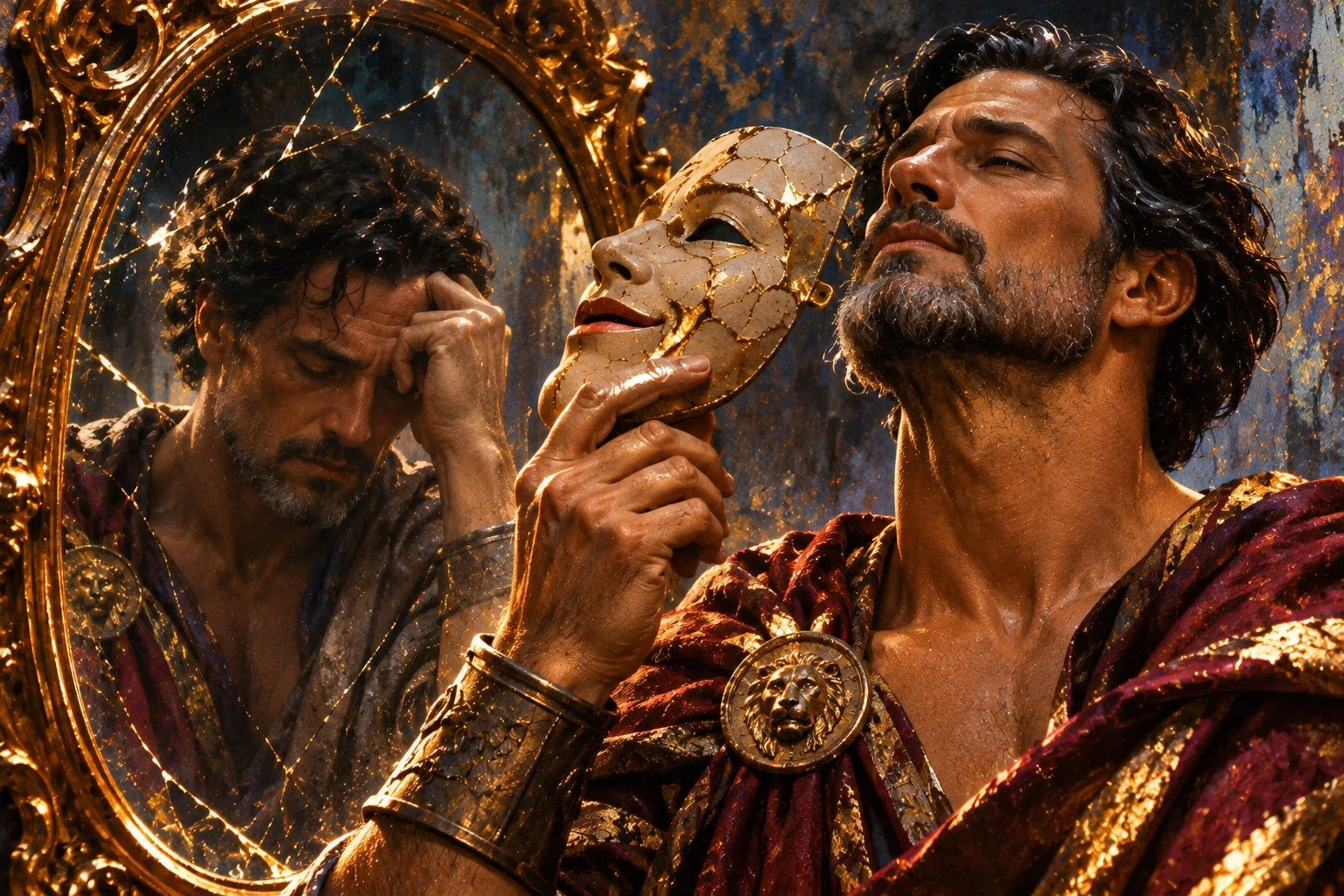
The Courage to Stop Pretending: Who Are We When Nobody Is Watching?
After exploring the masks we wear, the identities we construct, and the emotional consequences of pretending, we arrive at a question that may be more difficult than any other.
Who are we when nobody is watching?
Not the person we become at work. Not the personality we present on social media. Not the version of ourselves that friends, family, or romantic partners have grown accustomed to seeing. Who are we when there is no audience to impress, no reputation to protect, and no expectation demanding that we behave a particular way?
I believe answering that question requires a kind of courage that society rarely celebrates. We admire people who conquer extraordinary obstacles, achieve financial success, overcome physical challenges, and demonstrate strength in the face of adversity. Yet we often overlook the courage required to acknowledge our own insecurities, admit when we are wrong, or tell someone that we are hurting. There is courage in saying that you are tired when everyone expects you to remain strong. There is courage in admitting that a relationship no longer makes you happy, even when others believe it is perfect. There is courage in abandoning an identity that once earned admiration but no longer reflects the person you have become.
And there is tremendous courage in accepting that not everyone will appreciate the person you truly are. This does not mean we should abandon social boundaries, reveal every private thought, or treat emotional vulnerability as an obligation. Not everyone deserves access to our deepest feelings, and protecting personal boundaries can be an expression of wisdom rather than fear. Authenticity is not the absence of privacy. It is the ability to live without constantly betraying our own values, emotions, and convictions for the sake of approval.
Perhaps this is where we must reconsider what it means to be strong. A strong person is not necessarily someone who never cries, never doubts themselves, or never experiences fear. Strength can also involve acknowledging painful realities and choosing to confront them rather than hiding behind an image of perfection. A warrior who admits that he is wounded does not become less courageous. He becomes someone capable of recognizing what must heal.
And perhaps the same is true of all of us.
We spend years developing identities designed to protect us from rejection, humiliation, disappointment, and emotional pain. Some of these defenses help us survive difficult experiences, while others eventually prevent us from developing meaningful relationships with the people around us.
The challenge is learning to distinguish between the two.
When does confidence become arrogance? When does independence become emotional isolation? When does kindness become an inability to establish boundaries? When does resilience become an excuse to ignore our own suffering? And when does the person we pretend to be begin replacing the person we actually are?
These questions rarely have simple answers because human identity is not fixed. We change as we grow older, encounter new experiences, form relationships, and reconsider beliefs that once seemed unquestionable.
The objective should not be to discover one permanent version of ourselves and remain unchanged forever. It should be to develop enough self-awareness to recognize when we are living according to our own convictions and when we are merely performing for the approval of others.
We may never completely stop wearing masks. But perhaps we can learn to remove them when it matters most.
Final Thoughts: The Greatest Performance Is the One We Give Ourselves
Warriors, throughout history, artists have used portraits, masks, surrealism, and symbolism to examine the complicated relationship between appearance and identity. Frida Kahlo showed us the emotional power of divided selfhood, James Ensor exposed the unsettling possibilities of social disguise, and René Magritte reminded us that what remains hidden can be just as important as what we see.
Their works continue to resonate because the questions they raise are not confined to museums or art history.
They belong to all of us.
Every person carries private experiences that the world may never fully understand. Every individual has moments of uncertainty, vulnerability, and contradiction. And nearly everyone has, at some point, presented a version of themselves designed to gain acceptance, avoid rejection, or survive difficult circumstances.
I don't believe pretending is always a sign of weakness or dishonesty. Sometimes it is a response to pain. Sometimes it is a necessary form of protection. Sometimes we simply haven't discovered how to express what we genuinely feel.
But I do believe there is a profound danger in allowing the performance to consume our identity. Imagine reaching the end of your life and realizing that you spent decades trying to become someone everyone else would admire, only to discover that you never gave yourself permission to become the person you wanted to be.
What a terrible price to pay for acceptance.
Perhaps the greatest battle we will ever fight isn't against the people who misunderstand us, criticize us, or refuse to accept us. Perhaps it is the battle against the identity we have spent years constructing to avoid those very experiences. A warrior may survive countless battles wearing armor, but he must eventually learn that peace cannot be experienced through an impenetrable shield. And perhaps we must learn the same lesson about the masks we wear.
We spend so much of our lives trying to convince the world that we are someone worth loving that we sometimes forget to ask whether we love the person we have become. So the next time you find yourself standing before a mirror, take a moment to consider the person looking back at you. Not the professional. Not the parent. Not the partner. Not the successful individual. Not the personality everyone expects you to maintain.
Just you.
And ask yourself one final question:
If nobody were watching, nobody were judging, and nobody expected anything from you, would you still choose to be the person you are today? Because perhaps the greatest masterpiece we will ever create is not the image we convince the world to admire. It is the life we finally have the courage to live without pretending.
Until next time, Warriors.
The world may fall in love with your mask. But never forget the person beneath it deserves to be loved, too.
— Peter Romulus | The Romulus Kingdom